
Getting Past the ‘Digital Divide’. From “flickr,” by Ben Newman 2011 https://www.flickr.com/photos/39817003
Copyright 2011 by Ben Newman
As noted by Warschauer, M. 2003 (as cited in Warschauer, M. (2007) Over the last decade, the term digital divide has been widely used to indicate unequal access to digital technology. Meaning the gap between availability, accessibility and the acquisition of technology is definite, these factors contribute to a digital divide. Throughout history there has always been a divide between the haves and have nots of society. As an educator, considering these indicating factors will improve inclusion and active participation by all individuals bridging the gap.
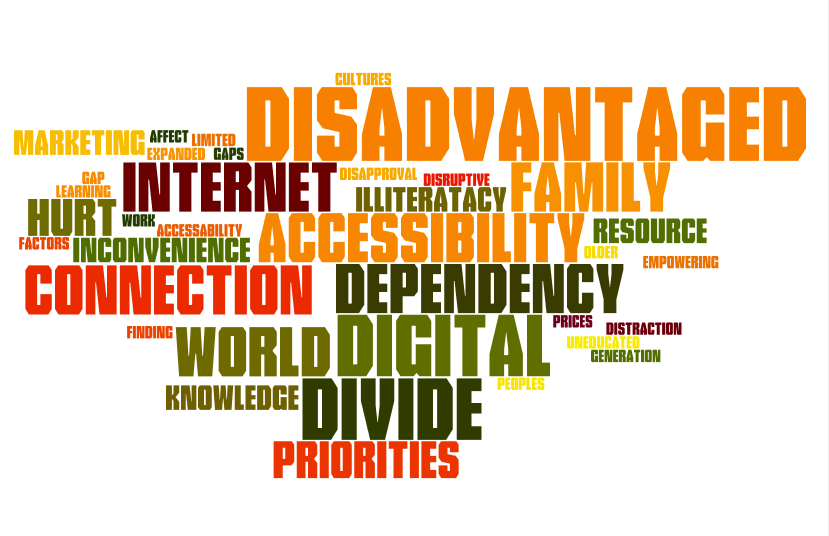
Indigenous communities and lower socio-economic communities including aged individuals contribute to the digital divide, factoring in regional and demographic placement and also the skills and knowledge needed to use digital devices. Warschauer (2007) points out that there is evidence to suggest that low-income families and low-income schools have a lack of internet access at home and limited access to technology, thus, impacting on their opportunities to become digitally fluent. Only one out of five Australians have access to the internet and clearly highlights that there is very much a ‘digital divide’ within Australia (Howell, 2012).
Bridging the gap is important and technology is vastly changing offering adequate accessibility, next will be the cost. Most people and families have mobile phones in which are proving a definite source to bridge this gap with updated technology, social inclusion based on social media applications, and the freedom to browse. Schools are readily providing technology funded by government, companies or non-profit organisations in order to support children, encourage participation and inclusion further developing lifelong learning in the digital age.
References
Figure 3. Getting Past the ‘Digital Divide’. From “flickr,” by Ben newman 2011 https://www.flickr.com/photos/39817003 Copyright 2011 by Ben Newman
Figure 3.1 Digital Divide. google images,
Bentley, P. (2014). lack of affordable broadband creating ‘digital divide’. melbourne: Abc radio.
Howell, J. (2012). Teaching with ICT: Digital Pegagogies for collaboration and creativity . Melbourne, VIC: Oxford University Press.
Warschauer, M. (2007). A Teacher’s Place in the Digital Divide. Yearbook of the National Society for the Study of Education.
 Teaching and Learning in the Digital World